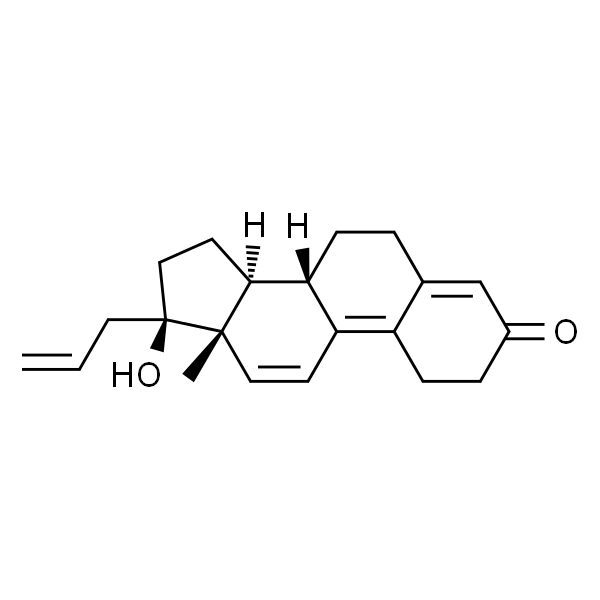
Treatment of embryo-recipient mares with altrenogest appears to be beneficial in extending the degree of donor-recipient synchrony required for successful embryo transfer. Altrenogest treatment also seems to be conductive to pregnancy maintenance in recipients experiencing luteal dysfunction.[1]
In Vitro
Altrenogest (Allyltrenbolone) is a progestogen structurally related to veterinary steroid trenbolone. Treatment of embryo-recipient mares with Altrenogest (Allyltrenbolone) appears to be beneficial in extending the degree of donor-recipient synchrony required for successful embryo transfer[1]. The oil and gel Altrenogest (Allyltrenbolone) preparations are equally effective in modulating estrous behavior and time to estrus and ovulation. Altrenogest (Allyltrenbolone) treatment started late in diestrus appears to result in a high incidence of ovulation during treatment and when luteolysis and ovulation occur during treatment; the subsequent luteal phase is frequently prolonged due to failure of regression of the CL[2].
The response to 15-d altrenogest treatment (Experiment 1) was characterized in 20 mares that were given 22 mg daily of altrenogest in oil (n = 10) or in gel (n = 10) from Day 10 to 25 after ovulation. [2]
数据来源文献
[1]. Parry-Weeks, L.C. and D.W. Holtan, Effect of altrenogest on pregnancy maintenance in unsynchronized equine embryo recipients. J Reprod Fertil Suppl, 1987. 35: p. 433-8. [2]. Daels, P.F., et al., Persistence of the luteal phase following ovulation during altrenogest treatment in mares. Theriogenology, 1996. 46(5): p. 799-811.
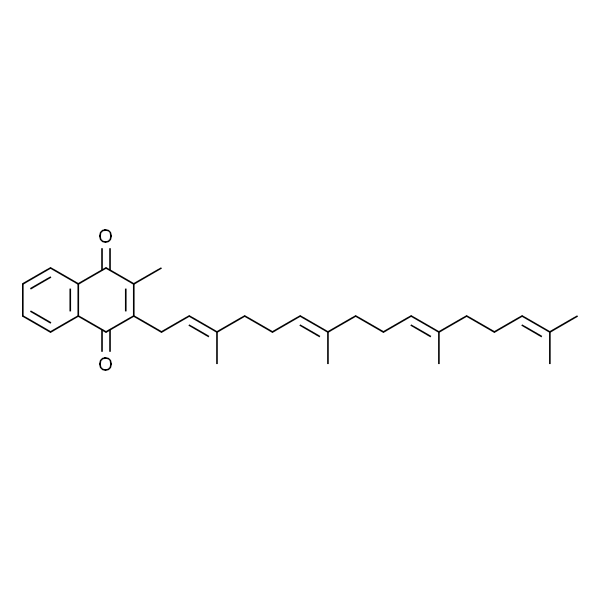
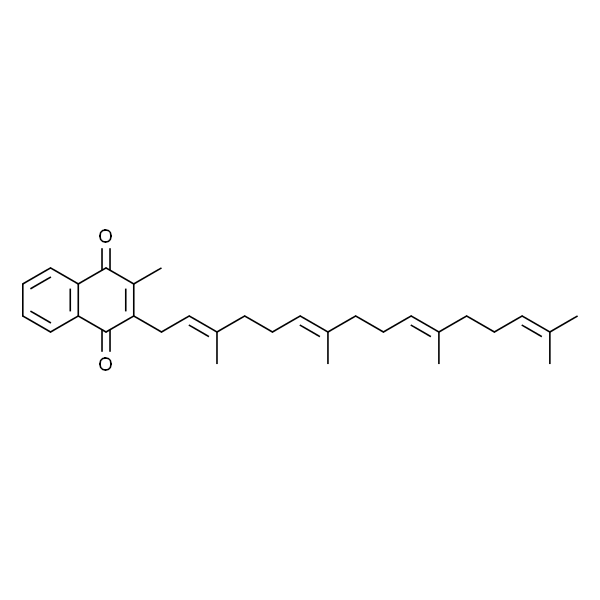
将Caco-2细胞以2-5×10 4个细胞/ cm 2的密度接种到35-mm培养皿上。将细胞温育2至3天直至60%-70%汇合,并加入所需浓度的甲基萘醌-4(0,1.0,5.0和10.0μM)。载体的最终浓度为培养基的0.1%,培养基每周更换两次。在添加Menaquinone-4 [1]后第0,3,7和11天测定细胞。
数据来源文献
[1]. Noda S, et al. Menaquinone-4 (vitamin K2) up-regulates expression of human intestinal alkaline phosphatase in Caco-2 cells. Nutr Res. 2016 Nov;36(11):1269-1276. [2]. Kim M, et al. Vitamin K1 (phylloquinone) and K2 (menaquinone-4) supplementation improves bone formation in a high-fat diet-induced obese mice. J Clin Biochem Nutr. 2013 Sep;53(2):108-13.