ELISA试剂盒—特异性检测疫苗诱导的免疫反应

金畔ELISA试剂盒—特异性检测疫苗诱导的免疫反应

ELISA法可以用来检测和评估疫苗的效价。金畔QuantiCyto®ELISA试剂盒,品质卓越,行业领先,在国内众多重点实验室广泛使用,恒瑞医药、海正药业等药物研发企业,荷兰阿姆斯特丹大学等海外研究机构,深受广大科研人员的好评。金畔ELISA试剂盒自推出以来已被超过1300篇SCI文献引用,其中包括Nature,Advanced materials,PNAS, Nature Immunology, Cellresearch等顶级期刊文献,同时有超过3000篇国内核心期刊、博士及硕士学位论文引用。

金畔部分热销ELISA产品如下:

ELISA试剂盒—特异性检测疫苗诱导的免疫反应

* 所有产品均可提供48T / 96T / 96T*2 / 96T*5 / 96T*10不同规格,部分产品可提供高敏度试剂盒

* 还提供多因子检测服务,每孔仅需25~50ul样本,就可同时检测多达50个指标!

如需购买以上产品或其它相关产品,请联系我们上海金畔生物

胶原抗体诱导小鼠关节炎模型

胶原抗体诱导小鼠关节炎模型

胶原诱导性关节炎小鼠(CIA)作为人类类风湿关节炎模型应用广泛,但CIA引起的关节炎起病比较缓慢,造模周期较长,一般为6-8周(1-12)。Chondrex公司已开发出单一种单克隆抗体合剂诱导的小鼠关节炎模型(CAIA),明显缩短了造模周期。与CIA相比,CAIA模型具有以下优点: (1)可在大多数小鼠上诱发关节炎,包括CIA不敏感的小鼠;(2)CAIA造模周期短,加速筛选和评估类风湿性关节炎治疗药物;(3)应用于转基因小鼠来研究基因对关节炎发病的影响;(4)用于研究与人类类风湿性关节炎相关的各种炎症介质和因素在疾病中的作用,例如细菌和病毒毒素(13-17)。

CAIA without LPS

胶原抗体诱导的关节炎(不加LPS)

CIA是由于自身抗体形成的免疫复合物通过激活补体而诱发关节炎症,因此研究表明多克隆胶原蛋白抗体(8-19) 或单克隆胶原蛋白抗体合剂能诱发关节炎(20-21)。根据MHC类型,这些自身反应性抗体可以识别位于小鼠II型胶原蛋白的CB11或者CB8片段中的特定抗原定簇(关节炎抗原表位)(22-23)。

Chondrex公司生产的能诱发小鼠关节炎的抗体合剂含有 : A2-10 (IgG2a), F10-21 (IgG2a), D8-6 (IgG2a), D1-2G(IgG2b), and D2-112 (IgG2b). 其中两个单克隆抗体(F10-21和D8-6)识别在LysC-2(291-374)的83个氨基酸肽段,该肽段有LysC内切酶作用产生。 另外三个单克隆抗体(A2-10,D1-2G和D2-112) 能够识别二型胶原蛋白CB11片段(124-402)中LysC-1(124-290)的167各氨基酸肽段(13)。这些抗原表位氨基酸序列在各种物种中具有高度保守性,包括鸡,小鼠,大鼠,牛,猪,猴子和人 (20-21)。

CAIA with LPS

胶原抗体诱导的关节炎(加LPS)

研究表明,联合注射低于致炎剂量的单克隆抗体合剂和大肠杆菌多脂(LPS)可诱发严重的小鼠关节炎(13)。通过胃肠道吸收的细菌毒素(如LPS)与低致炎水平的二型胶原自身抗体对引发关节炎有发协同作用(24)。这种模型相比于传统CIA 模型有多重优势。第一,起病时间短,发病率高达100%。第二,可在大多数小鼠上诱导关节炎,包括CIA不敏感的小鼠,T细胞缺陷的小鼠,特定基因敲除变异的小鼠,详情请见表二.

图一显示CIA模型和CAIA模型特点的比较。CAIA造模周期是CIA建模周期的十分之一。

图一 CAIA vs. CIA: (a)三角形:100%的小鼠在LPS注射后24-48小时即可见关节炎发作,在第5-7天病情达到高峰。(b)圆形:CIA诱发小鼠关节炎模型一般需要4周起病,即使使用CIA易感品系,如DBA/1J和B10.RIII小鼠。

表二 关节炎炎症程度的临床评分

得分 发病情况
0 Normal 正常
1 Mild, but definite redness and swelling of the ankle or wrist, or apparent redness and swelling limited to individual digits, regardless of the number of affected digits 轻度的、踝关节、腕关节发红、肿胀
2 Moderate redness and swelling of ankle or wrist 踝关节或腕关节中度发红肿胀
3 Severe redness and swelling of the entire paw including digits 爪子严重发红、肿胀,包括指端
4 Maximally inflamed limb involving multiple joints 四肢最大程度发炎,包括多关节

引用文献:

1. E. Trentham, A. Townes, A. Kang, Autoimmunity to Type II Collagen an Experimental Model of Arthritis. J Exp Med. 146,857-68 (1977).

2. J. Courtenay, M. Dallman, A. Dayan, A. Martin, B. Mosedale,Immunisation Against Heterologous Type II Collagen Induces Arthritis in Mice. Nature. 283, 666-8 (1980).

3. S. Cathcart, K. C. Hayes, W. A. Gonnerman, A. A. Lazzari,C. Franzblau, Experimental Arthritis in a Nonhuman Primate. I.Induction by Bovine Type II Collagen. Lab Invest. 54, 26-31(1986).

4. P. Wooley, Collagen-induced arthritis in the mouse.Methods Enzymol 162, 361-373 (1988).

5. P. Wooley, H. Luthra, M. Griffiths, J. Stuart, A. Huse, C.David, et al., Type II Collagen-Induced Arthritis in Mice. IV.Variations in Immunogenetic Regulation Provide Evidence for Multiple Arthritogenic Epitopes on the Collagen Molecule. JImmunol. 135, 2443-51 (1985).

6. R. Holmdahl, L. Jansson, E. Larsson, K. Rubin, L.Klareskog, Homologous Type II Collagen Induces Chronic and Progressive Arthritis in Mice. Arthritis Rheum. 29, 106-13 (1986).

7. R. Ortmann, E. Shevach, Susceptibility to Collagen-Induced Arthritis: Cytokine-Mediated Regulation. Clin Immunol. 98, 109-18 (2001).

8. W. C. Watson, A. S. Townes, Genetic Susceptibility to Murine Collagen II Autoimmune Arthritis. Proposed Relationship to the IgG2 Autoantibody Subclass Response, Complement C5,Major Histocompatibility Complex (MHC) and non-MHC Loci. JExp Med. 162, 1878-91 (1985).

9. K. Campbell, J. A. Hamilton, I. P. Wicks, Collagen-induced Arthritis in C57BL/6 (H-2b) Mice: New Insights Into an Important Disease Model of Rheumatoid Arthritis. Eur J Immunol. 30, 1568-75 (2000).

10. E. Michaëlsson, V. Malmström, S. Reis, A. Engström, H.Burkhardt, R. Holmdahl, et al., T Cell Recognition of Carbohydrates on Type II Collagen. J Exp Med 180, 745-9(1994).

11. M. Andersson, R. Holmdahl, Analysis of Type II CollagenReactive T Cells in the Mouse. I. Different Regulation of Autoreactive vs. Non-Autoreactive Anti-Type II Collagen T Cells in the DBA/1 Mouse. Eur J Immunol 20, 1061-6 (1990).

12. R. Reife, N. Loutis, W. Watson, K. Hasty, J. Stuart, SWRMice Are Resistant to Collagen-Induced Arthritis but Produce Potentially Arthritogenic Antibodies. Arthritis Rheum. 34, 776-81

(1991).

13. K. Terato, D. Harper, M. Griffiths, D. Hasty, X. Ye, et al.,Collagen-induced Arthritis in Mice: Synergistic Effect of E. ColiLipopolysaccharide Bypasses Epitope Specificity in the Induction

of Arthritis With Monoclonal Antibodies to Type II Collagen.Autoimmunity 22, 137-47 (1995).

14. S. Yoshino, E. Sasatomi, Y. Mori, M. Sagai, Oral Administration of Lipopolysaccharide Exacerbates CollagenInduced Arthritis in Mice. J Immunol. 163, 3417-22 (1999).

15. B. Cole, M. Griffiths, Triggering and Exacerbation of Autoimmune Arthritis by the Mycoplasma Arthritidis Superantigen MAM. Arthritis Rheum. 36, 994-1002 (1993).

16. Y. Takaoka, H. Nagai, M. Tanahashi, K. Kawada,Cyclosporin A and FK-506 Inhibit Development of SuperantigenPotentiated Collagen-Induced Arthritis in Mice. Gen Pharmacol.30, 777-82 (1998).

17. T. Kagari, H. Doi and T. Shimozato. The importance of IL-1β and TNF-α, and the noninvolvement of IL-6, in the development of monoclonal antibody-induced arthritis. J Immunol 169,1459-1466 (2002).

20. K. Terato, K. Hasty, R. Reife, M. Cremer, A. Kang, J. Stuart,et al., Induction of Arthritis With Monoclonal Antibodies to Collagen. J Immunol 148, 2103-8 (1992).

21. P. Hutamekalin, T. Saito, K. Yamaki, N. Mizutani, D. Brand,et al., Collagen Antibody-Induced Arthritis in Mice: Development of a New Arthritogenic 5-clone Cocktail of Monoclonal Anti-Type II Collagen Antibodies. J Immunol Methods 343, 49-55 (2009).

22. K. Terato, K. A. Hasty, M. A. Cremer, J. M. Stuart, A. S.Townes, A. H. Kang, et al., Collagen-induced Arthritis in Mice.Localization of an Arthritogenic Determinant to a Fragment of the Type II Collagen Molecule. J Exp Med. 162, 637-46 (1985).

23. L. Myers, H. Miyahara, K. Terato, J. Seyer, A. Kang,Collagen-induced arthritis in B10.RIII mice (H-2r): identification of an arthritogenic T cell determinant. Immunol 84, 509-513 (1995).

更多资料或相关产品,请联系Chondrex全国代理-上海金畔生物

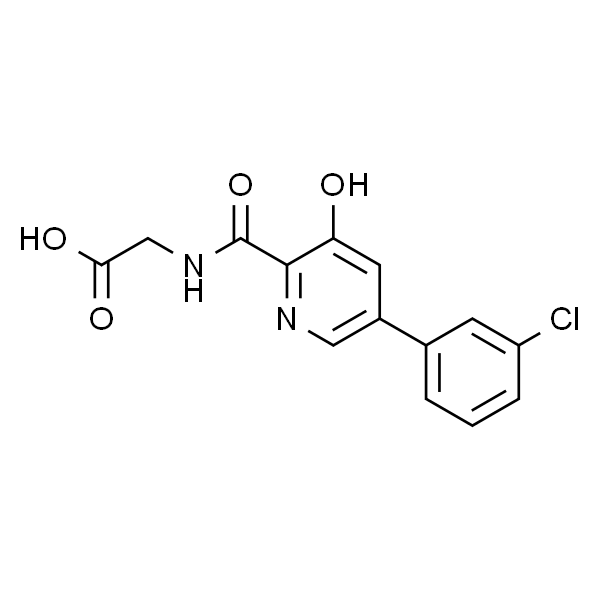
伐度司他

伐度司他

货号:
IV0640

品牌:
Jinpan

伐度司他

暂无详情
产品简介
别名 AKB-6548, PG-1016548
英文名称 Vadadustat
CAS 1000025-07-9
分子式 C14H11ClN2O4
分子量 306.7
储存条件 -20℃
纯度 Purity≥98%
单位
生物活性 Vadadustat是一种新型的可滴定口服的缺氧诱导因子脯氨酰羟化酶 (HIF-PH) 抑制剂,目前开发用于治疗贫血。[1-2]
In Vitro Vadadustat诱导内源性促红细胞生成素合成并增强铁的动员。 Vadadustat在健康志愿者和患有慢性肾病的患者中具有良好的耐受性,其以剂量依赖性方式增加网织红细胞,血浆EPO和Hb水平。用伏达他汀观察到的血浆EPO水平的增加在数量上与在中等高度的生理学上发生的相当,并且显示正常的昼夜模式,在下一次剂量之前返回到基线水平。 Vadadustat通过降低铁调素和增加转铁蛋白水平来改善铁稳态。每日一次口服vadadustat,滴定以增加和维持Hb在目标范围内,可提供优于传统ESAs的多重优势[1]。观察到Vadadustat的半衰期约为4.5小时。总体而言,患者表现出Hb水平增加,从基线时的9.91 g / dL增加到第29天的10.54 g / dL。到第29天,铁蛋白水平从基线时的334.1 ng / mL降至271.7 ng / mL [2]。
靶点 HIF/HIF Prolyl-Hydroxylase
数据来源文献 [1]. Pergola PE, et al. Vadadustat, a novel oral HIF stabilizer, provides effective anemia treatment in nondialysis-dependent chronic kidney disease. Kidney Int. 2016 Nov;90(5):1115-1122.
[2]. Gupta N, et al. Hypoxia-Inducible Factor Prolyl Hydroxylase Inhibitors: A Potential New Treatment for Anemia in Patients With CKD. Am J Kidney Dis. 2017 Feb 24. pii: S0272-6386(17)30110-5.
规格 2mg 5mg

Vadadustat 是一种新型的HIF-PH抑制剂。

胶原蛋白诱导小鼠关节炎实验方案(一)

胶原蛋白诱导小鼠关节炎实验方案(一)

BACKGROUND

背景知识

胶原蛋白诱发(CIA) 的小鼠关节炎与人类类风湿关节炎具有共同的免疫学和病理学特征。因此CIA模型被广泛应用于研究致病机理和治疗方案的研究 (1-3)。尽管该模型具有高度可重复性,但要成功诱导高发病率和严重程度的关节炎,一些影响造模的因素需要考虑。以下是成功诱发小鼠关节炎的一些重要因素。因此,建议首次造模者需要考虑这些因素,确定可行性方案。

A. Animal Vendors

动物来源

即使同样品系的小鼠来自不同的供应商也可能会造成实验结果的差异,Chondrex公司建议开展实验前先测试不同供应商提供的小鼠。

B. Housing Condition & Diet

饲养条件和饮食

为 避 免 细 菌 和 病 毒 感 染 在 实 验 中 引 起 的 差 异 ,Chondrex公司建议在无特定病原体 (SPF级) 条件下饲养动。 一般来说,对于肠道菌群,不管是否致病都显著影响宿主对抗原的免疫应答。 例如,对于感染肝炎病毒(MHV)的小鼠,胶原蛋白不能诱发关节炎。饮食也会影响关节炎的发病率和严重程度, CIA 在饲喂不同饲料的小鼠中差异很大。饲喂高脂肪的食物更容易引起高发病率关节炎(5)。

C. Mouse Age & Strains

小鼠年龄和品系

建议使用具有成熟免疫系统的7-8周龄的小鼠。老龄小鼠可能对CIA的易感性较差。Chondrex公司建议在重复实验中使用相同周龄的小鼠。小鼠对CIA的易感性与MHC-II 类分子相关(6), 同时也取决于接种二型胶原蛋白的小鼠品系。DBA/1(H-2q) 和B10.RIII(H-2r) 品系的小鼠被广泛应用,因为这两个品系对CIA高度易感。DBA/1(H-2q)小鼠,对鸡,牛和猪二型胶原有免疫应答。B10.RIII小鼠对牛和猪二型胶原有免疫应答,但对鸡而型胶原的免疫应答较弱。两种品系小鼠对小鼠的二型胶原蛋白免疫应答较弱,关节炎发生率低于10% (7)。

另一方面,CIA 抗性的小鼠也可能产生关节炎抗体。表明小鼠对 CIA 的敏感性不仅取决于MHC类型。 研究表明, CIA抗性的小鼠 C57BL/6, 129/Sv (H-2b), and Balb/c(H-2d) ,当 INF-g 和 IL-10 基因敲除后,小鼠能产生关节炎自身抗体从而发生关节炎。这表明,对关节炎的敏感性也取决于不同细胞因子水平(8)。

列表一为用于CIA及抗胶原蛋白抗体诱导(CAIA)的关节炎动物模型研究的常用小鼠品系.

Mouse Strain H-2

Type

CIA

Susceptibility

Ref #

CAIA

Susceptibility

Ref#

Note
DBA/1 q High 2, 5, 6 High

13,21

INFγ high
B10.Q q High 6 (High)
B10.G q High 6 (High)
NFR/N q High 38 (High)
SWR q Resistant 17 Resistant C5 deficient
B10.RIII r High 6 High 13 Low response:chick and human type II
B10 b Low 10 (High) * Need alternative immunization
C57BL/6 b Low 10

Moderate -High

9,18,30 LPS low

responder –* Need

alternative

immunization

C57BL/6

beige

b Resistant 20 Resistant PMN

mutation

C57BL/6 x

129/Sv

b Low 10

Moderate -High

30,31 * Need

alternative

immunization

129/Sv b Resistant 10 High 27
B10.D2/nSn d Resistant 20 High 20
B10.D2/oSn d Resistant 20 Resistant 20 C5 deficient
Balb/c d Resistant High 13
Balb/c nu/nu d Resistant Resistant 28 B & T cell

deficient

C3H/He k low 38 (Low)
B10.S s Resistant 5 ?
SJL/1 s Moderate 2 (High)

C.B-17

scid/scid

Resistant High 18 B & T cell

deficient

*Develops arthritis by alternative immunization with CFA containing high concentrations of M.tuberculosis. *需要含高剂量结核杆菌的CFA诱导关节炎

D. Adjuvant

佐剂

含有结核杆菌的完全佐剂对于诱发小鼠关节炎很重要。不同于大鼠,二型胶原加不完全佐剂(不含结核杆菌)无法诱导小鼠关节炎。产生抗体,包括IgG2a抗体对于激活补体及随后的关节炎的发生具有重要作用,取决于完全佐剂中结核杆菌的含量。最近,Campbell 用CFA(5mg/ml)在对CIA 抗性的小鼠中成功诱发高发病率的关节炎(50-70%),例如:C57BL/6,B10, and 129/Sv mice (H-2b) (10)。然而含高浓度结核杆菌的完全佐会诱发严重的炎症, 所以佐剂浓度(结核杆菌含量)取决于各研究单位动物管理委员会要求。以下是Chondrex,公司的佐剂列表。

Catalog # Description
7002 Incomplete Freund’s Adjuvant, 5 ml
7008 Freund’s Adjuvant, 5 ml x 1 mg/ml
7009 Freund’s Adjuvant, 5 ml x 2 mg/ml
7015 Freund’s Adjuvant, 5 ml x 3 mg/ml
7001 Freund’s Adjuvant, 5 ml x 4 mg/ml
7023 Freund’s Adjuvant, 5 ml x 5 mg/ml

REFERENCES

参考文献

1. D. Trentham, A. Townes, A. Kang, Autoimmunity to Type II Collagen an Experimental Model of Arthritis. J Exp Med 146,857-68 (1977).

2. J. Courtenay, M. Dallman, A. Dayan, A. Martin, B. Mosedale,Immunisation Against Heterologous Type II Collagen Induces Arthritis in Mice. Nature 283, 666-8 (1980).

3. E. Cathcart, K. Hayes, W. Gonnerman, A. Lazzari, C.Franzblau, Experimental Arthritis in a Nonhuman Primate. I.Induction by Bovine Type II Collagen. Lab Invest 54, 26-31(1986).

5. P. Wooley, Collagen-induced arthritis in the mouse.Methods Enzymol 162:361-373, 1988.

6. P. Wooley, H. Luthra, M. Griffiths, J. Stuart, A. Huse, C.David, et al., Type II Collagen-Induced Arthritis in Mice. IV.Variations in Immunogenetic Regulation Provide Evidence for Multiple Arthritogenic Epitopes on the Collagen Molecule.J Immunol 135, 2443-51 (1985).

7. R. Holmdahl, L. Jansson, E. Larsson, K. Rubin, L.Klareskog, Homologous Type II Collagen Induces Chronic and Progressive Arthritis in Mice. Arthritis Rheum 29, 106-13 (1986).

8. R. Ortmann, E. Shevach, Susceptibility to Collagen-Induced Arthritis: Cytokine-Mediated Regulation. Clin Immunol 98,109-18 (2001).

10. I. Campbell, J. Hamilton, I. Wicks, Collagen-induced Arthritis in C57BL/6 (H-2b) Mice: New Insights Into an Important Disease Model of Rheumatoid Arthritis. Eur J Immunol 30,1568-75 (2000).

17. R. Reife, N. Loutis, W. Watson, K. Hasty, J. Stuart, SWR Mice Are Resistant to Collagen-Induced Arthritis but Produce Potentially Arthritogenic Antibodies. Arthritis Rheum 34, 776-81 (1991).

20. W. Watson, P. Brown, J. Pitcock, A. Townes, Passive Transfer Studies With Type II Collagen Antibody in B10.D2/old and New Line and C57Bl/6 Normal and Beige(Chediak-Higashi) Strains: Evidence of Important Roles for C5 and Multiple Inflammatory Cell Types in the Development of Erosive Arthritis. Arthritis Rheum 30, 460-5(1987).

38. R. Holmdahl, L. Jansson, M. Andersson, E. Larsson, Immunogenetics of Type II Collagen Autoimmunity and Susceptibility to Collagen Arthritis. Immunology 65, 305-10 (1988).

如需完整资料或咨询相关问题,请联系Chondrex代理商–上海金畔生物

胶原抗体诱导小鼠关节炎模型之动物饲养条件和饮食

胶原抗体诱导小鼠关节炎模型之动物饲养条件和饮食

Animal Care and Diet

动物饲养条件和饮食

建立CAIA模型需要选择7-8周龄小鼠。老龄鼠的发病率和病情严重程度较低。建议在无特定病原体(SPF级别)条件下饲养动物,因为细菌感染会降低宿主的免疫应答,从而减轻关节炎症。肠道菌群会影响宿主免疫系统对LPS 的易感性。LPS甚至会引起某些对LPS超级易感品系的小鼠致死。Chondrex公司建议在开展实验前先测试实验用小鼠对LPS的易感性。尽管饮食影响可以不用考虑,但是Chondrex公司建议饲喂高脂肪食物,研究表明高脂肪食物更容易引发炎症 (4)。

Mouse Strains

小鼠品系

注射抗二型胶原单克隆抗体合剂可以绕过宿主生成抗二型胶原自身抗体的需求,所以可以诱发MHC (例如H-2q和H-2r)缺陷的小鼠产生关节炎.所有能产生正常炎症反应和补体激活的小鼠品系都应该对CAIA敏感。

图一为目前为止测试过的小鼠品系。

DBA/1 (H-2q) and B10.RIII (H-2r) 小鼠对CIA和CAIA均有较高的敏感性(13)。

BALB/c (H-2d) 小鼠对CIA具有抗性,但对CAIA有较高敏感性,是目前最常用的品系(25-27)。

T细胞缺陷的C.B-17 scid/scid 小鼠可用于CAIA,因为在炎症发生的过程中,不需要T细胞识别抗原来产生抗体(17)。这中品系小鼠相比正常T细胞的小鼠,会产生更严重的关节炎症, T细胞在愈合过程中有调节炎症的作用。

SWR(H-2q)小鼠具有CIA易感基因型,但由于C5缺陷,对CIA 和CAIA具有抗性。 其他C5缺陷小鼠,例如B10.D2/oSn 和 NOD/LtSz scid/scid 对 CAIA 具 有 抗 性(12,19,27).

尽管裸大鼠对CAIA具有高易感性, 裸小鼠对CAIA具有抗性(29)。裸小鼠可能缺乏特定的促炎细胞因子的表达。

图一-用于胶原 CIA 及 胶原蛋白抗体诱导(CAIA )的关节炎动物模型研究的常用小鼠品系

*需要含结核杆菌的CFA佐剂诱导关节炎

C57BL/6小鼠是转基因小鼠模型中最常用的品系。尽管C57BL/6小鼠对LPS不敏感,但CAIA联合LPS 会使这些小鼠产生严重的关节炎症。在这种品系的小鼠中建模需要使用高剂量单克隆抗体合剂,每只小鼠需要5mg(21,30).C57BL/6 与129/Sy小鼠杂交用于建立基因敲除小鼠。一些杂交小鼠会对LPS有应答,所以1.5mg每只小鼠的剂量一会产生严重的关节炎症(30-31) 。

以下基因敲除小鼠用于基因对CAIA模的影响 (29-39).

1) NOS2 knockout mice (30)

2) Osteopontin knockout mice (31)

3) COX-1 and COX-2 knockout mice (32)

4) MMP-2 (gelatinase A) and MMP-3 (gelatinase B) knockout

mice (33)

5) P2X7 receptor knockout mice (34)

6) c-Jun N-Terminal Kinase knockout mice (35)

7) Prostaglandin E2 receptor knockout mice (36)

8) CD69 null mice (37)

相关文献:

4. P. Wooley, Collagen-induced arthritis in the mouse.Methods Enzymol 162, 361-373 (1988).

12. R. Reife, N. Loutis, W. Watson, K. Hasty, J. Stuart, SWR Mice Are Resistant to Collagen-Induced Arthritis but Produce Potentially Arthritogenic Antibodies. Arthritis Rheum. 34, 776-81(1991).

13. K. Terato, D. Harper, M. Griffiths, D. Hasty, X. Ye, et al.,Collagen-induced Arthritis in Mice: Synergistic Effect of E. Coli Lipopolysaccharide Bypasses Epitope Specificity in the Induction of Arthritis With Monoclonal Antibodies to Type II Collagen.Autoimmunity 22, 137-47 (1995).

17. T. Kagari, H. Doi and T. Shimozato. The importance of IL-1β and TNF-α, and the noninvolvement of IL-6, in the development of monoclonal antibody-induced arthritis. J Immunol 169,1459-1466 (2002).

19. W. Watson, P. Brown, J. Pitcock, A. Townes, Passive Transfer Studies With Type II Collagen Antibody in B10.D2/old and New Line and C57Bl/6 Normal and Beige (Chediak-Higashi) Strains: Evidence of Important Roles for C5 and Multiple Inflammatory Cell Types in the Development of Erosive Arthritis.Arthritis Rheum. 30, 460-5 (1987).

25. P. M. Wallace, J. F. MacMaster, K. A. Rouleau, T. J. Brown,J. K. Loy, et al., Regulation of Inflammatory Responses by Oncostatin M. J Immunol. 162, 5547-55 (1999).

26. R. de Fougerolles, A. G. Sprague, C. L. Nickerson-Nutter,G. Chi-Rosso, P. D. Rennert, et al., Regulation of Inflammation by Collagen-Binding Integrins alpha1beta1 and alpha2beta1 in

Models of Hypersensitivity and Arthritis. J Clin Invest. 105, 721-9(2000).

27. S Larox, J. Fuseler, D. Merril, L. Gray, R. Reife, K. Terato,et al. #301 A novel model of polyarthritis induced in mice using monoclonal antibodies to type II collagen. Characterization and

effects of chemically modified tetracycline. Arthritis Rheum 42:s121 (supplement).

29. K. Takagishi, N. Kaibara, T. Hotokebuchi, C. Arita, M.Morinaga, K. Arai, et al., Serum Transfer of Collagen Arthritis in Congenitally Athymic Nude Rats. J Immunol. 134, 3864-7 (1985).

30. H. Kato, K. Nishida, A. Yoshida, I. Takada, C. McCown, et al., Effect of NOS2 Gene Deficiency on the Development of Autoantibody Mediated Arthritis and Subsequent Articular Cartilage Degeneration. J Rheumatol. 30, 247-55 (2003).

31. K. Yumoto, M. Ishijima, S. Rittling, K. Tsuji, Y. Tsuchiya, et al., Osteopontin Deficiency Protects Joints Against Destruction in Anti-Type II Collagen Antibody-Induced Arthritis in Mice. Proc Natl Acad Sci U S A 99, 4556-61 (2002).

32. L. Myers, A. Kang, A. Postlethwaite, E. Rosloniec, S. Morham, et al., The Genetic Ablation of Cyclooxygenase 2 Prevents the Development of Autoimmune Arthritis. Arthritis Rheum 43, 2687-93 (2000).

33. T. Itoh, H. Matsuda, M. Tanioka, K. Kuwabara, S. Itohara, R. Suzuki, et al., The Role of Matrix metalloproteinase-2 and Matrix metalloproteinase-9 in Antibody-Induced Arthritis. J Immunol 169, 2643-7 (2002).

34. J. Labasi, N. Petrushova, C. Donovan, S. McCurdy, P. Lira,et al., Absence of the P2X7 Receptor Alters Leukocyte Function and Attenuates an Inflammatory Response. J Immunol 168,6436-45 (2002).

35. Z. Han, L. Chang, Y. Yamanishi, M. Karin, G. Firestein, Joint Damage and Inflammation in c-Jun N-terminal Kinase 2 Knockout Mice With Passive Murine Collagen-Induced Arthritis. Arthritis Rheum 46, 818-23 (2002).

36. J. McCoy, J. Wicks, L. Audoly, The Role of Prostaglandin E2 Receptors in the Pathogenesis of Rheumatoid Arthritis. J Clin Invest 110, 651-8 (2002).

37. R. Newton, K. Solomon, M. Covington, C. Decicco, P. Haley, et al., Biology of TACE Inhibition. Ann Rheum Dis 60 Suppl 3, 25-32 (2001).

38. R. Holmdahl, L. Jansson, M. Andersson, E. Larsson,Immunogenetics of Type II Collagen Autoimmunity and

Susceptibility to Collagen Arthritis. Immunology. 65, 305-10(1988).

39. S. Thornton, G. Boivin, K. Kim, F. Finkelman, R. Hirsch, Heterogeneous Effects of IL-2 on Collagen-Induced Arthritis. J Immunol 165, 1557-63 (2000).

更多资料或相关产品,请联系Chondrex全国代理-上海金畔生物

链脲佐菌素—诱导动物糖尿病模型

链脲佐菌素—诱导动物糖尿病模型

 糖尿病是一种慢性病,当胰腺产生不了足够的胰岛素或者人体无法有效地利用所产生的胰岛素时,就会出现糖尿病。全世界有3.47亿人患有糖尿病。2004年,估计有340万人死于空腹高血糖带来的后果。2010年的估计死亡数字与之相似。世卫组织预测,2030年糖尿病将成为第七位主要死因。目前我国的糖尿病的发病率呈升高趋势,但发病机理尚未完全阐明,在预防和治疗方面仍不完善,建立理想的动物模型对进一步研究糖尿病具有重要的意义。


迄今为止,已建立了多种建立糖尿病动物模型的方法,主要有:(1) 手术切除胰腺;(2) 化学药物诱导;(3) 自发性DM;(4) 转基因动物等。其中化合药物诱导法中采用链脲佐菌素注射造模因其对组织毒性较小,动物存活率高,所以是目前国内外使用较多的一种制备糖尿病动物模型的方法。

链脲佐菌素(英语:Streptozotocin或Streptozocin,简称STZ,又名链佐星、链脲霉素)是一种由链球菌产生的,对哺乳动物胰脏中产生胰岛素的胰岛B细胞有着特异毒性的天然化合物。它能破坏胰岛B细胞,大剂量可诱导I型糖尿病,小剂量反复注射可致II型糖尿病。

Enzo Lifesciences目前可提供以下三种规格链脲佐菌素供广大研究者选用。
 

 品牌
 产品编号
 产品名称
 规格
 ENZO
 ALX-380-010-G001
 Streptozotocin
 1 x 1 g
 ENZO
 ALX-380-010-5100
 Streptozotocin
 5 x 100 mg
 ENZO
 ALX-380-010-M100
 Streptozotocin
 1 x 100 mg


产品文献引用
1. Streptozotocin induces G2 arrest in skeletal muscle myoblasts and impairs muscle growth in vivo: A.P. Johnston, et al.; Am. J. Physiol. Cell Physiol. 292, C1033 (2007).
2. Genotoxicity of streptozotocin: A.D. Bolzan & M.S. Bianchi; Mutat. Res. 512, 121 (2002), (Review).
3. The mechanism of alloxan and streptozotocin action in B cells of the rat pancreas: T. Szkudelski; Physiol. Res. 50, 537 (2001), (Review).
4. N-monomethyl-arginine and nicotinamide prevent streptozotocin-induced double strand DNA break formation in pancreatic rat islets: F.J. Bedoya, et al.; Experientia 52, 344 (1996).
5. Nitric oxide generation during cellular metabolization of the diabetogenic N-methyl-N-nitroso-urea streptozotozin contributes to islet cell DNA damage: K.-D. Kroncke, et al.; Biol. Chem. Hoppe Seyler 376, 179 (1995).
6. Nitric oxide generation from streptozotocin: N.S. Kwon, et al.; FASEB J. 8, 529 (1994).
7. Biochemical evidence for nitric oxide formation from streptozotocin in isolated pancreatic islets: J. Turk, et al.; BBRC 197, 1458 (1993).
8. NO- and NO2-carrying molecules potentiate photorelaxation in rat trachea and aorta: K.C. Chang, et al.; BBRC 191, 509 (1993).
9. Streptozotocin: a nitric oxide carrying molecule and its effect on vasodilation: G. Thomas & P. Ramwell; Eur. J. Pharmacol. 161, 279 (1989).
10. Mouse models of insulin dependent diabetes: low-dose streptozocin-induced diabetes and nonobese diabetic (NOD) mice: H. Kolb; Diabetes Metab. Rev. 3, 751 (1987).
11. Alkylation of DNA in rat tissues following administration of streptozotocin: R.A. Bennett & A.E. Pegg; Cancer Res. 41, 2786 (1981).
12. The structure of streptozotocin: R.R. Herr, et al.; JACS 89, 4808 (1967).
13. Studies on the diabetogenic action of streptozotocin: N. Rakieten, et al.; Cancer Chemother. Rep. 29, 91 (1963).

更多详情请咨询ENZO代理商-上海金畔生物

Chondrex — 抗同型半胱氨酸诱导内质网蛋白抗体篇

Chondrex — 抗同型半胱氨酸诱导内质网蛋白抗体篇

通过筛选活跃的狼疮肾炎患者外周淋巴细胞的cDNA库,同型半胱氨酸诱导内质网蛋白被发现作为一个潜在的诱导抗DNA抗体模拟抗原。Herp位于不同类型细胞膜内质网膜上。病毒感染,缺氧或者钙离子失调等应激情况下,该蛋白的量上调。Chondrex能够提供用于WBELISA实验的小鼠Herp蛋白单克隆抗体。


Herp抗体

货号

产品英文名

中文名称

交叉反应

应用

规格

7039

Anti-Human Herp Antibody, Clone HT2

抗人Herp抗体

H

ELISA

IHC

WB

1 mg/ml x 0.1 ml

7040

Anti-Human Herp Antibody, Clone HT2, Biotinylated

生物素化抗人Herp抗体

H

ELISA

IHC

WB

1 mg/ml x 0.1 ml


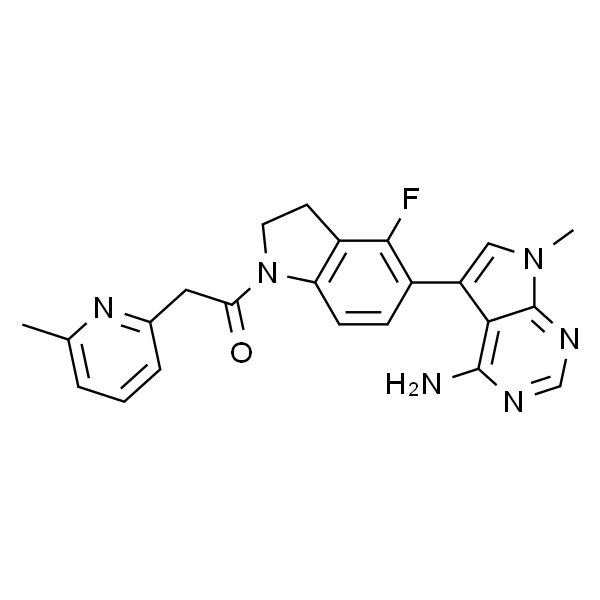
GSK2656157

GSK2656157

货号:
IG1320

品牌:
Jinpan

GSK2656157

暂无详情
产品简介
英文名称 GSK2656157
CAS 1337532-29-2
分子式 C23H21FN6O
分子量 416.45
储存条件 -20°C
纯度 ≥98%
单位
生物活性 GSK2656157 是选择性,ATP竞争性的 PERK 抑制剂,IC50 值为 0.9 nM[1-4]。
In Vitro GSK2656157抑制LPS诱导的IL-1β产生,LPS诱导的Caspase 1活化和LPS诱导的eIF-2α磷酸化,但不抑制LPS诱导的TNF-α产生[3]。GSK2656157导致PERK活化的抑制以及下游底物,磷酸-eIF2α,ATF4和CHOP的降低,在BxPC3胰腺肿瘤细胞系中IC50在10-30nM的范围内。在UPR诱导之前暴露于1μMGSK2656157的细胞能够阻止这种对从头蛋白质合成的影响[1]。 GSK2656157引起另一种eIF2α激酶的激活以补偿HT1080细胞中PERK活性的丧失。 GSK2656157抑制HT1080细胞的生长[2]。
In Vivo GSK2656157(1.5-150mg/kg,po)导致磷酸-PERK Thr980的剂量依赖性抑制,在50和150mg/kg时抑制超过80%。 GSK2656157(50-150mg/kg,po)导致人肿瘤异种移植模型中肿瘤生长的剂量依赖性抑制[1]。
激酶实验 用DMSO或不同浓度的GSK2656157处理BxPC3(人胰腺癌)或LL/2(鼠肺癌)细胞1小时,然后加入5μg/ mL衣霉素或1μM毒胡萝卜素另外6小时以诱导内质网应激。在冷放射免疫沉淀测定(RIPA)缓冲液[150mM NaCl,50mM Tris-Cl pH 7.5,0.25%脱氧胆酸钠,1%NP-40,蛋白酶抑制剂和100mM原钒酸钠]中裂解细胞。通过SDS-PAGE分离澄清的裂解物,并使用NuPAGE系统转移至硝酸纤维素膜。将印迹与抗PERK,p-eIF-2αSer51,总eIF-2α,ATF4和CHOP的抗体一起温育。 IRDye700DX标记的山羊抗小鼠免疫球蛋白G(IgG),IRDye800-CW驴抗山羊IgG和IRDye800-CW山羊抗兔IgG用作二抗。在Odyssey红外成像仪上检测蛋白质。
SMILES CC1=CC=CC(CC(N2CCC3=C2C=CC(C4=CN(C)C5=NC=NC(N)=C54)=C3F)=O)=N1
靶点 PERK
动物实验 将指数生长的HPAC(5×10⁶细胞/小鼠),Capan-2(10×106细胞/小鼠)或NCI-H929(1×6细胞/小鼠)细胞皮下植入8-12-右侧。一周龄雌性SCID小鼠。类似地,将每只小鼠10×106个BxPC3细胞植入雌性裸鼠中。当肿瘤大小达到约200mm 3时,称重动物,并根据肿瘤大小随机分组到每组8只小鼠的治疗组中。小鼠口服给药配方载体或GSK2656157。称重小鼠并用卡尺每周两次测量肿瘤。计算肿瘤体积。使用下式计算肿瘤测量的每一天的肿瘤生长抑制百分比:100×[1-(化合物处理的肿瘤的平均生长/载体处理的对照肿瘤的平均生长)]。
细胞实验 将BxPC3细胞用DMSO或1μMGSK2656157处理1小时,然后再加入5μg/ mL衣霉素一小时。细胞用125μCi35S-甲硫氨酸代谢标记随后1小时。在冷RIPA缓冲液中裂解细胞,通过SDS-PAGE分离裂解物,然后暴露于磷成像仪筛。对照细胞也用100μM环己酰胺预处理1小时,然后进行代谢标记。
数据来源文献 [1]. Atkins C, et al. Characterization of a novel PERK kinase inhibitor with antitumor and antiangiogenic activity. Cancer Res. 2013 Mar 15;73(6):1993-2002.
[2]. Krishnamoorthy J, et al. Evidence for eIF2α phosphorylation-independent effects of GSK2656157, a novel catalytic inhibitor of PERK with clinical implications. Cell Cycle. 2014 Mar 1;13(5):801-6.
[3]. Ando T, et al. GSK2656157, a PERK inhibitor, reduced LPS-induced IL-1β production through inhibiting Caspase 1 activation in macrophage-like J774.1 cells. Immunopharmacol Immunotoxicol. 2016 Aug;38(4):298-302.
[4]. Zhao Q, et al. Thioredoxin-interacting protein links endoplasmic reticulum stress to inflammatory brain injury and apoptosis after subarachnoid haemorrhage. J Neuroinflammation. 2017 May 11;14(1):104.
规格 5mg 10mg 25mg

GSK2656157 是选择性,ATP竞争性的 PERK 抑制剂。

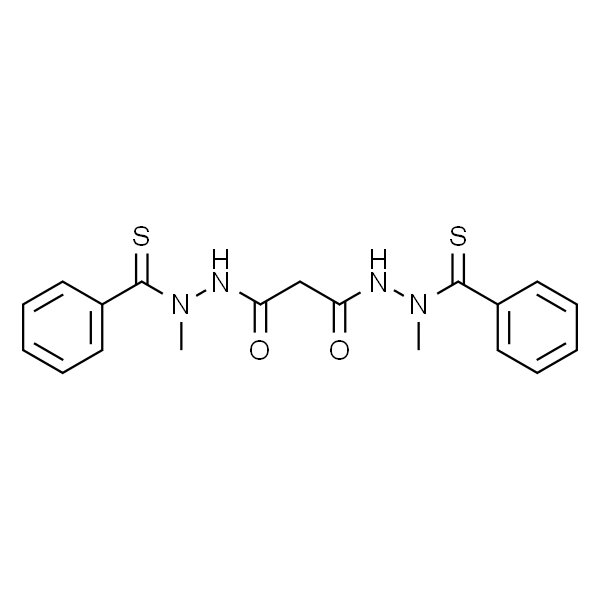
Elesclomol;伊利司莫

Elesclomol;伊利司莫

货号:
IE0680

品牌:
Jinpan

Elesclomol;伊利司莫

暂无详情
产品简介
别名 STA-4783
英文名称 Elesclomol
CAS 488832-69-5
分子式 C19H20N4O2S2
分子量 400.52
纯度 ≥98%
单位
生物活性 Elesclomol是一种氧化应激诱导剂,可诱导癌细胞凋亡[1-4]。
In Vitro Elesclomol显著诱导热休克应激反应基因和金属硫蛋白基因的表达,这是指示Hs294T细胞中氧化应激的标志性转录谱。 Elesclomol(100 nM)迅速诱导Hsp70 RNA水平,在1小时时增加4.8倍,在Ramos Burkitt淋巴瘤B细胞中6小时增加160倍,与细胞内ROS含量一致,早在0.5%时增加20%在6小时时,小时和385%,并且抗氧化剂N-乙酰半胱氨酸(NAC)和Tiron预处理可以阻断Hsp70的诱导。 Elesclomol通过诱导氧化应激使早期和晚期凋亡细胞的数量增加3.7倍和11倍,氧化应激可被NAC完全阻断,而对正常细胞几乎没有影响[1]。 Elesclomol显著抑制SK-MEL-5,MCF-7和HL-60的细胞活力,IC50分别为110 nM,24 nM和9 nM [2]。 Elesclomol在酵母中诱导铜依赖性ROS产生和细胞毒性。 elesclomol不是通过特定的细胞蛋白质靶标,而是与电子传递链(ETC)相互作用,这是一种在线粒体中发生的生物学连贯过程,在细胞器内产生高水平的ROS,从而导致细胞死亡[3]。
In Vivo 尽管elesclomol(25-100mg/kg)在人乳腺癌(MDA435,MCF7和ZR-75-1),肺癌(RER)或淋巴瘤(U937)的裸鼠异种移植模型中没有显示出抗肿瘤活性。在肿瘤消退和小鼠延长存活方面,Elesclomol在这些模型中显著增强化学治疗剂如紫杉醇的功效[4]。
SMILES S=C(C1=CC=CC=C1)N(NC(CC(NN(C(C2=CC=CC=C2)=S)C)=O)=O)C
靶点 Apoptosis;HSP70
细胞实验 对于活力测定,将HBL和HBL-ρ0细胞与300nM elesclomol-Cu或Cu孵育24小时。使用碘化丙锭(PBS中5μg/ mL)染色和FACS分析测定细胞死亡。通过在流式细胞术之前立即将细胞(25×104/mL)与40nM DIOC6(3)在37℃温育15分钟来测量内部线粒体跨膜电位。
数据来源文献 [1]. Kirshner JR, et al. Elesclomol induces cancer cell apoptosis through oxidative stress. Mol Cancer Ther. 2008 Aug;7(8):2319-27.
[2]. Bair JS, et al. Chemistry and biology of deoxynyboquinone, a potent inducer of cancer cell death. J Am Chem Soc. 2010 Apr 21;132(15):5469-7
[3]. Blackman RK, et al. Mitochondrial electron transport is the cellular target of the oncology drug elesclomol. PLoS One. 2012;7(1):e29798.
[4]. Gehrmann M. Drug evaluation: STA-4783–enhancing taxane efficacy by induction of Hsp70. Curr Opin Investig Drugs. 2006 Jun;7(6):574-80
规格 2mg 5mg 10mg

是一种氧化应激诱导剂,可诱导癌细胞凋亡。

胶原抗体诱导小鼠关节炎模型之CAIA实验方案

胶原抗体诱导小鼠关节炎模型之CAIA实验方案

PROTOCOL TO INDUCE CAIA

CAIA实验方案

Chondrex公司建议尾静脉注射单克隆抗体合剂。对于易感品系,可采用腹腔注射,但是通过腹腔注射CAIA诱发的炎症严重程度往往较低,关节炎持续时间也较短。请根据实验目的选择合适的实验方案。

Catalog Number Amount
53100 100mg
53040 40mg
53010


A. Inducing CAIA without LPS

胶原抗体诱导的关节炎

在易感品系DBA/1和Balb/c小鼠中采用CAIA建立关节炎模型,根据动物供应商,动物周龄和体积大小的不同,每只小鼠需注射6-10mg单克隆抗体合剂。例如,初次注射免疫5mg抗体合剂后24小时再次注射5mg抗体合剂。关节炎会在二次免疫后的24-48小时后发生。研究员需要根据实验目的调整实验方案。

B. Inducing CAIA with LPS 

胶原抗体联用LPS诱导的关节炎

细菌毒素LPS(B细胞分裂素), MAM(支原体产生的T细胞分裂素)或SEB(金黄色葡萄球菌产生的T 细胞分裂素)和胶原抗体在诱发关节炎中具有协同效应。在这些毒素的存在下,诱导关节炎的抗体合剂的量可降低。例如,每只小鼠初次免疫注射1.5mg抗体合剂后第三天注射25-50µgLPS,对于易感品系小鼠(Balb/c, DBA/1,B10.RIII, and C.B-17 scid/scid mice),关节炎的发生率高达100%。在C57BL/6小鼠尾部静脉注射5mg抗体合剂,关节炎在初次免疫后第7-10天达到最严重, 可维持两周。在初次免疫第10或14天注射25-50µgLPS, 关节炎会持续恶化。尽管三周后炎症反应有所缓解,关节破坏是永久性的,甚至导致关节强直。

EVALUATING ARTHRITIS

关节炎评估

关节炎可通过临床评分来定性评估或用测厚仪来测量爪子厚度来评估。由于小鼠的爪子太小,因此无法像测量大鼠爪子体积那样通过浸没法测定小鼠爪子体积。

Chondrex公司提供以下评分系统(表二)

表二 关节炎炎症程度的临床评分

得分 发病情况
0 Normal 正常
1 Mild, but definite redness and swelling of the ankle or wrist, or apparent redness and swelling limited to individual digits, regardless of the number of affected digits 

轻度的、踝关节、腕关节发红、肿胀

2 Moderate redness and swelling of ankle or wrist 踝关节或腕关节中度发红肿胀
3 Severe redness and swelling of the entire paw

including digits

爪子严重发红、肿胀,包括指端

4 Maximally inflamed limb involving multiple joints 四肢最大程度发炎,包括多关节

表三 成功阻断单克隆抗体诱发的关节炎的药物

更多资料或相关产品,请联系Chondrex全国代理-上海金畔生物