InVivoMAb rat IgG2b isotype control, anti-keyhole limpet hemocyanin(货号:BE0090)
推荐抗体稀释液
InVivoPure™ pH 7.0 Dilution Buffer(货号:IP0070)
免疫原
CBA mouse thymocytes
应用
in vivo CD8+ T cell depletion
Western blot
产品形式
PBS , pH 7.0
Contains no stabilizers or preservatives
内毒素水平
<2eu>
使用 LAL gel clotting 测定
纯度
>95% Determined by SDS-PAGE
无菌处理
0.2 μM filtered
生产形式
从组织培养上清液中纯化得到。
纯化形式
Protein G
RRID
AB_10950145
分子量大小
150 kDa
保存条件
抗体原溶液应保存在4°C条件下,不要冷冻保存。
已发表参考文献:
in vivo CD8+ T cell depletion
Triplett, T. A., et al. (2018). “Reversal of indoleamine 2,3-dioxygenase-mediated cancer immune suppression by systemic kynurenine depletion with a therapeutic enzyme.” Nat Biotechnol 36(8): 758-764.
in vivo CD8+ T cell depletion
Vashist, N., et al. (2018). “Influenza-Activated ILC1s Contribute to Antiviral Immunity Partially Influenced by Differential GITR Expression.” Front Immunol 9: 505.
in vivo CD8+ T cell depletion
Burrack, K. S., et al. (2015). “Myeloid Cell Arg1 Inhibits Control of Arthritogenic Alphavirus Infection by Suppressing Antiviral T Cells.” PLoS Pathog 11(10): e1005191.
Anti-ZO1 tight junction protein antibody (ab59720)抗ZO1紧密连接蛋白抗体产品信息:
Product name:Anti-ZO1 tight junction protein antibodySee all ZO1 tight junction protein primary antibodies …
Description
Rabbit polyclonal to ZO1 tight junction protein
Specificityab59720 recognises both ZO1 tight junction alpha-minus and alpha-plus isoforms. The protein is abundant in endothelial cells and the highly specialized epithelial junctions. Although we have an image for IHC-Fr, customers report variable results in this application. If you would like to use in IHC-Fr then we suggest using ethanol instead of acetone. Although we have references for IHC-P, customers report variable results in this application. IHC-Fr and IHC-P are therefore not covered by our Abpromise guarantee.
Our Abpromise guarantee covers the use of ab59720 in the following tested applications.
The application notes include recommended starting dilutions; optimal dilutions/concentrations should be determined by the end user.
Application
Notes
ICC/IF
ICC/IF: Use a concentration of 1 µg/ml.
Flow Cyt
Flow Cyt: 1/50.
IHC (PFA fixed)
IHC (PFA fixed): Use at an assay dependent concentration. PubMed: 21526120
WB
WB: 1/50. Predicted molecular weight: 194 kDa.
IHC-P
IHC-P: Use at an assay dependent concentration.
Target
FunctionThe N-terminal may be involved in transducing a signal required for tight junction assembly, while the C-terminal may have specific properties of tight junctions. The alpha domain might be involved in stabilizing junctions.
Tissue specificityThe alpha-containing isoform is found in most epithelial cell junctions. The short isoform is found both in endothelial cells and the highly specialized epithelial junctions of renal glomeruli and Sertoli cells of the seminiferous tubules.
Sequence similaritiesBelongs to the MAGUK family. Contains 1 guanylate kinase-like domain. Contains 3 PDZ (DHR) domains. Contains 1 SH3 domain. Contains 1 ZU5 domain.
DomainThe second PDZ domain mediates interaction with GJA12.
Post-translational modificationsPhosphorylated. Dephosphorylated by PTPRJ.
Cellular localizationCell membrane. Cell junction > tight junction. Movement of ZO-1 from the cytoplasm to membrane is an early event occurring concurrently with cell-cell contact.
Information by UniProt
Database links
Entrez Gene: 7082 Human
Entrez Gene: 21872 Mouse
Omim: 601009 Human
SwissProt: Q07157 Human
SwissProt: P39447 Mouse
Unigene: 510833 Human
Unigene: 4342 Mouse
Alternative names
Tight junction protein 1 antibody
Tight junction protein ZO-1 antibody
Tight junction protein ZO1 antibody
Anti-ZO1 tight junction protein antibody images
Immunocytochemistry/ Immunofluorescence – Anti-ZO1 tight junction protein antibody (ab59720)
ab59720 staining ZO1 in Caco-2 cells treated with (±)-palmitoylcarnitine chloride (ab141122), by ICC/IF. Membranar ZO1 expression loss correlates with increased concentration of (±)-palmitoylcarnitine chloride, as described in literature. The cells were incubated at 37°C for 1 hour in media containing different concentrations of ab141122 ((±)-palmitoylcarnitine chloride) in DMSO, fixed with 4% formaldehyde for 10 minutes at room temperature and blocked with PBS containing 10% goat serum, 0.3 M glycine, 1% BSA and 0.1% tween for 2h at room temperature. Staining of the treated cells with ab59720 (0.5 μg/ml) was performed overnight at 4°C in PBS containing 1% BSA and 0.1% tween. A DyLight 488 anti-rabbit polyclonal antibody (ab96899) at 1/250 dilution was used as the secondary antibody. Nuclei were counterstained with DAPI and are shown in blue.
Immunocytochemistry/ Immunofluorescence – ZO1 tight junction protein antibody (ab59720)
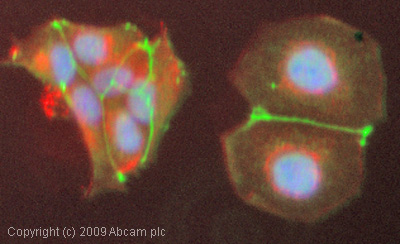
ICC/IF image of ab59720 stained MCF-7 cells. The cells were 4% formaldehyde fixed (10 min) and then incubated in 1%BSA / 10% normal goat serum / 0.3M glycine in 0.1% PBS-Tween for 1h to permeabilise the cells and block non-specific protein-protein interactions. The cells were then incubated with the antibody (ab59720, 1µg/ml) overnight at +4°C. The secondary antibody (green) was Alexa Fluor® 488 goat anti-rabbit IgG (H+L) used at a 1/1000 dilution for 1h. Alexa Fluor® 594 WGA was used to label plasma membranes (red) at a 1/200 dilution for 1h. DAPI was used to stain the cell nuclei (blue) at a concentration of 1.43µM.
Immunocytochemistry/ Immunofluorescence – Anti-ZO1 tight junction protein antibody (ab59720)This image is courtesy of an anonymous Abreview
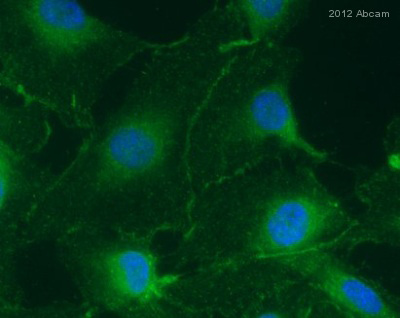
Immunofluorescence analysis of HUVEC cells, staining ZO1 tight junction protein with ab59720. Cells were fixed with paraformaldehyde, permeabilized with 0.1% Triton X-100 and blocked with 1% BSA for 30 minutes at 25°C. Samples were incubated with primary antibody (1/200 in diluent) for 16 hours at 4°C. An AlexaFluor®488-conjugated goat anti-rabbit polyclonal IgG (1/500) was used as the secondary antibody.
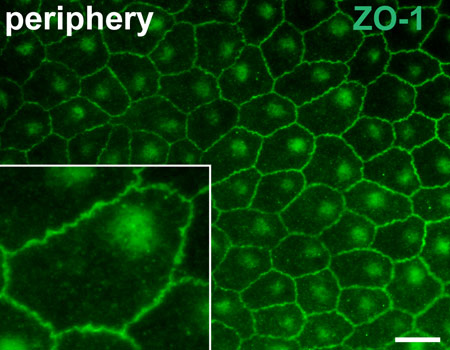
Immunocytochemistry/ Immunofluorescence – Anti-ZO1 tight junction protein antibody (ab59720)Image from Kokkinopoulos I et al., PLoS One. 2011 Apr 22;6(4):e18921. Fig 6.; doi:10.1371/journal.pone.0018921; April 22, 2011, PLoS ONE 6(4): e18921.
Immunofluorescence analysis of murine peripheral retinal pigmented epithelium (RPE) cells, staining ZO1 tight junction protein with ab59720.
Cells were fixed with 4% paraformaldehyde for 10 minutes at room temperature. Cells were blocked in 10% BSA and 0.5% Triton-X 100 for 2 hours at room temperature before being incubated with primary antibody (1/100) in blocking solution overnight at room temperature. An AlexaFluor®-conjugated anti-rabbit IgG was used as the secondary antibody.